Home / Writing / The Concord ReviewHistory research & writing · November 2026 intake The Concord Review A leading history journal
Aiming for a global top 30 university?
Aim higher. Go deeper. Make your work count.
An exceptional academic challenge
Serious history. An original history paper. A demanding editorial standard. An opportunity to show how deeply you can think.
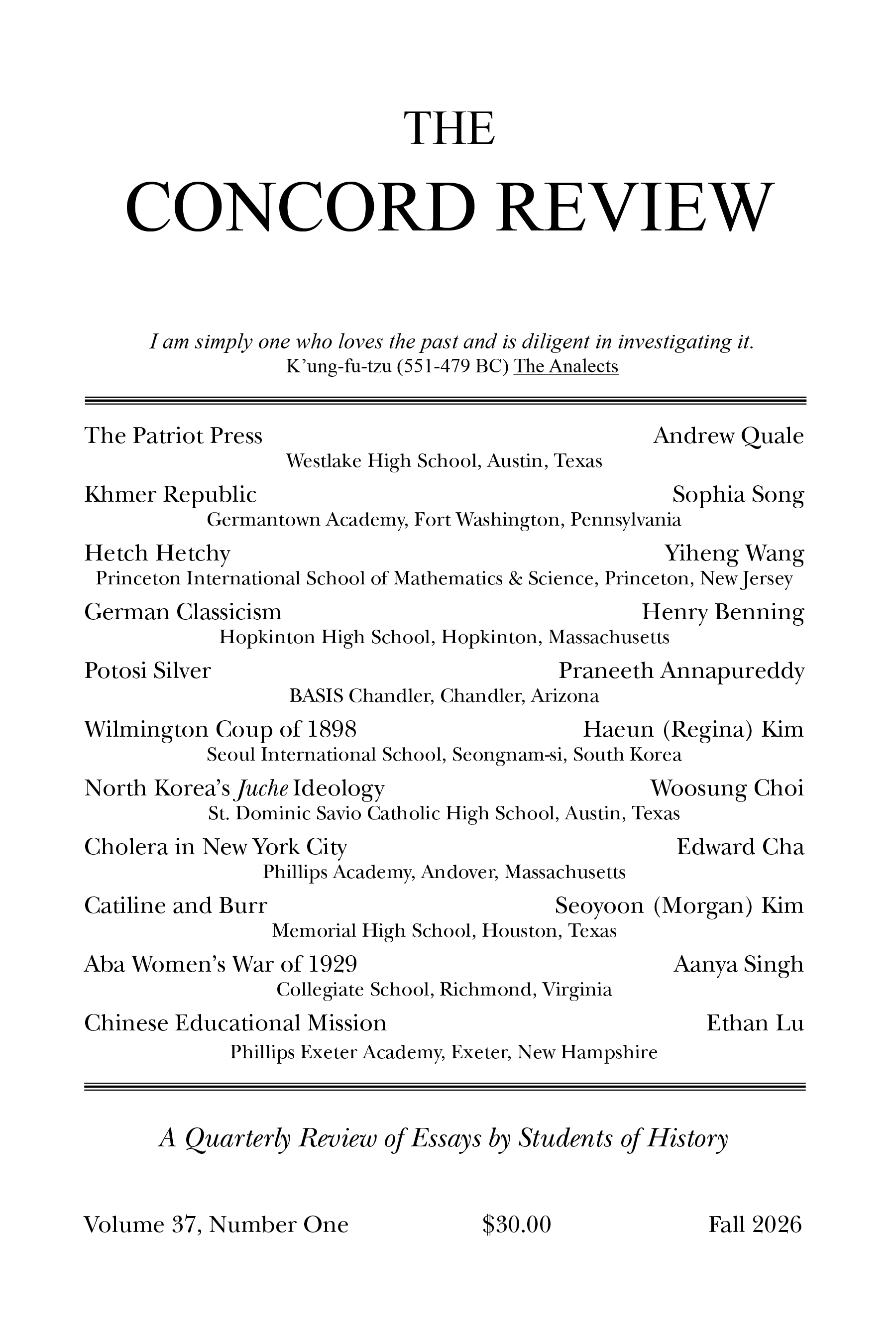
Official journal · Fall 2026 ↗ What is The Concord Review? An international journal publishing outstanding history research by secondary students. Since 1987, it has given young historians a platform for substantial, original scholarship.
Choose a question that matters to you. Investigate the evidence. Build an argument worth reading.
Meet the journal ↗ For students with bigger academic ambitions. Develop the depth, independence and sustained effort that demanding university study calls for.
Where published authors have gone on to study
Harvard Yale Princeton Stanford MIT
Author destinations reported by The Concord Review . These are journal-author outcomes, not ACE student results or a guarantee of admission.
Two formats. Real teacher support.
Choose how you get there. Learn at your own pace with personal feedback and accountability, or let a teacher guide you through the entire programme.
Flexibility + personal guidance Supported self-paced A$ 79820 lessons
Your pace, a clear plan. Follow the complete 20-lesson pathway.Three one-to-one teacher reviews. At the outline, first-draft and final-draft milestones.Guided reading. Complete reading analyses and summaries alongside your research.Human oversight every lesson. Homework and reading-summary completion are checked to keep you moving.1:1 Outline→ 1:1 First draft→ 1:1 Final draft
Choose supported self-paced → Teacher-led throughout · starts November Live Zoom small group A$ 1,99820 live sessions
A teacher at every stage. Guided reading, research, discussion and writing.A four-student group. More room to question, discuss and explain your thinking.20 × 90-minute sessions. A structured 12-week programme starting in November 2026.Detailed manuscript feedback. Three written full-draft reviews and a clear revision plan.Teacher-led Read → Research → Draft → Refine Guidance from the first question to the final manuscript.
Join the November intake → Choose a stage to explore its lessons, or view the entire course.
01 LESSONS 1–4 Foundations Read like a researcher. YOUR MILESTONE Foundation portfolio You complete: 1 Interest map & diagnostic analysis2 Published-essay analysis3 Source evaluations4 Two analytical paragraphsExplore stage 1 → 02 LESSONS 5–8 Research design Turn an interest into a question. YOUR MILESTONE Research proposal You complete: 1 Focused research question2 Annotated bibliography3 Claim-evidence matrix4 500–800-word proposal & outlineExplore stage 2 → 03 LESSONS 9–14 First draft Build and defend your argument. YOUR MILESTONE Complete first draft You complete: 1 Thesis & section plan2 Evidence-led body sections3 Introduction & conclusion4 Endnotes & bibliographyExplore stage 3 → 04 LESSONS 15–20 Final manuscript Refine your work for submission. YOUR MILESTONE Submission package You complete: 1 Revised independent paper2 Ten published-essay analyses3 Verified citations & revision log4 Final Word file & checklistExplore stage 4 →
Twenty lessons and the work students complete at each stage Lesson What you learn Student deliverable · what you complete STAGE 1 Research & Writing Foundations4 lessons · Foundation portfolio 01 What Is Historical Research? Connect questions, sources and arguments; assess research and writing skills. ✓ Interest map and a 300-word diagnostic analysis
02 How Published Essays Work Analyse a published essay’s question, structure, evidence, conclusion and references. ✓ Completed essay analysis and reading plan
03 Finding and Evaluating Sources Distinguish primary and secondary sources; examine context, perspective and reliability. ✓ Source log and three source-evaluation records
04 Writing Historical Analysis Link claims, evidence and reasoning; practise quotation, paraphrase and citation. ✓ Two analytical paragraphs with citations
STAGE 2 Topic Development & Research Design4 lessons · Research proposal 05 Choosing a Researchable Topic Define period, place and scope; assess significance and access to sources. ✓ Two topic briefs and a feasibility comparison
06 Finding a Scholarly Debate Compare historians’ explanations and identify a precise question. ✓ Research question and comparison of three interpretations
07 Building the Evidence Base Collect and cross-check sources; connect textual or numerical evidence to claims. ✓ Annotated bibliography and claim-evidence matrix
08 Research Proposal Workshop Defend the topic, test a working thesis and organise the argument. ✓ 500–800-word proposal and detailed outline SELF-PACED 1:1 · OUTLINE
STAGE 3 Argument Development & First Draft6 lessons · Complete first draft 09 Developing the Central Argument Refine the thesis and assign each section a distinct analytical purpose. ✓ Thesis statement, section plan and evidence map
10 Drafting I: Context and Explanation Select essential context and develop an explanation of causes or change. ✓ First body section with endnotes
11 Drafting II: Evidence and Comparison Analyse texts, events or data and explain how comparisons support the argument. ✓ Second body section with endnotes
12 Drafting III: Alternative Explanations Address counterevidence, compare rival explanations and qualify claims. ✓ Remaining sections and counterargument analysis
13 Writing the Introduction and Conclusion Establish the question and scholarly context; explain findings and significance. ✓ Draft introduction and conclusion
14 Completing the First Draft Integrate sections; check argument, transitions, endnotes and bibliography. ✓ Complete first draft and self-review checklist SELF-PACED 1:1 · FIRST DRAFT
STAGE 4 Research Refinement & Final Manuscript6 lessons · Submission package 15 Full-Manuscript Review I: Structure Evaluate the thesis, sequence and gaps; prioritise substantial revisions. ✓ Annotated draft, written feedback and revision plan · Written teacher feedback in the live course
16 Deepening the Research Resolve evidence gaps, corroborate sources and rewrite weak analytical sections. ✓ Updated evidence matrix and rewritten sections
17 Full-Manuscript Review II: Interpretation Test competing explanations and clarify the contribution and limits of findings. ✓ Revised manuscript, written feedback and response log · Written teacher feedback in the live course
18 Refining Academic English Improve paragraph focus, transitions, precision, concision and readability. ✓ Language-edited manuscript
19 Full-Manuscript Review III: Accuracy Audit facts, quotations and citations; check consistency and presentation. ✓ Written feedback, verified source log and final candidate · Written teacher feedback in the live course
20 Final Defence and Submission Preparation Explain findings, complete final corrections and review submission requirements. ✓ Final Word manuscript, word count and submission checklist SELF-PACED 1:1 · FINAL DRAFT
Every lesson ends with work you can show. Submit the set task and reading summary. Human progress checks help you stay on track.
Choose your support → Why prepare with ACE Achievers?
Ambition needs a system. University educators ↗ Visible milestones ↗ Human accountability ↗ Systematic progress ↗ 01 Designed and taught by educators from leading universities. Learn to read critically, ask sharper questions and explain a defensible argument.
01 Read closely02 Question assumptions03 Defend your thinking
02 Know what good progress looks like. Four stages, four concrete outputs. See what you need to finish before taking the next step.
01 Foundation portfolio02 Research proposal03 Complete draft04 Final manuscript
03 Your work gets noticed. Lesson tasks and reading summaries are checked, with personal feedback at the key moments.
01 Complete the task02 Submit your summary03 Human progress check
04 A clear target for every stage. Build skills in a deliberate sequence, from evaluating a source to producing a sustained piece of scholarship.
01 Read02 Research03 Write04 Revise
Start from November 2026
Make this your next challenge. Choose the rhythm that works for you. Keep the same ambitious target.
Concord course formats, timing, teacher support and price Your course When & how Teacher support Course fee Next step Supported self-paced20 online lessons Study at your paceAccess arrangements confirmed at enrolment 3 one-to-one reviewsPlus lesson-task and reading-summary checks A$798 Choose self-paced → Teacher-led Zoom4 students per group November 2026 intake20 × 90 minutes · 12 weeks Guidance throughoutLive teaching, discussion and manuscript feedback A$1,998 Join November →
Zoom session dates, times and time zone will be confirmed with your group. Allow 8–10 hours of independent work each week on the live programme.
Planning your submission Eligibility, deadlines and the final paper + Who & what International secondary students, including Australians. Complete the paper before finishing school and submit before university enrolment. Write an original, sole-authored English history paper.
The journal suggests 5,000–10,000+ words including notes and bibliography, with Chicago-style endnotes. Submit one Word or RTF file.
Official submission requirements ↗ Issue consideration dates
1 February Summer issue
1 May Fall issue
1 August Winter issue
1 November Spring issue Standing annual rules for 2026–2027. US issue names; check the organiser’s deadline time.
Official eligibility & deadlines ↗ Before you begin
Your questions, What does supported self-paced include? 20 lessons, guided reading, task and reading-summary completion checks, and three one-to-one teacher feedback sessions: outline, first draft and final draft. Course fee: A$798.
How does the live Zoom course work? A teacher leads a group of four students through 20 sessions of 90 minutes over 12 weeks. The November 2026 intake includes guided reading, research, discussion, writing and three written full-manuscript reviews. Course fee: A$1,998.
What will I produce? A substantial independent history paper, a research portfolio and a revision record. The course planning range is 6,000–8,000 words of main text, adjusted to your topic, plus endnotes and bibliography. You also complete ten published-essay analyses.
Does publication guarantee university admission? Published TCR authors have gone on to leading universities. Each university makes its own admission decisions, and the journal makes its own editorial decisions. Our course helps you develop your research, writing and original work.
Are journal submission fees included? The course fee covers ACE Achievers teaching and support. The journal charges its own submission fee separately. Check its official submission page for current fees.
What happens after I apply? We contact you to discuss readiness and confirm access or class arrangements. This enquiry form does not take payment or confirm a class place.
A bigger goal starts here
Take your ambition Choose your course. Bring your curiosity.
Supported self-paced A$798 Teacher-led Zoom A$1,998
Request enrolment now. We’ll confirm arrangements before payment.
ACE Achievers is an independent education provider. Students complete their own research and writing. Journal marks and cover imagery identify The Concord Review; no affiliation is implied.
Explore the writing competition calendar → Aim higher with ACE
Find your next writing challenge.